AD Guest Post
Brussels has no shortage of famous sights. The Grand Place, with its ornate guild houses and Gothic Town Hall, understandably sits near the top of most first-time itineraries. Yet staying only in the streets around the historic centre means seeing just one part of the Belgian capital.
Brussels becomes far more interesting when you start moving between its neighbourhoods. Within a relatively small area, elegant squares give way to second-hand shops, residential streets lined with Art Nouveau houses lead towards busy café terraces, and former trading districts have found new lives as places for independent shops and restaurants.
Many of these areas are close enough to combine on foot, while trams, buses and the metro make it easy to reach those further from the centre. For travellers with a little more time, exploring neighbourhood by neighbourhood is one of the best ways to understand how varied Brussels really is.
Table of Contents
ToggleSablon: chocolate, antiques and elegant streets
Sablon feels polished without being cut off from the rest of the city. Sitting just uphill from the historic centre, the area has long been associated with antiques, art galleries and some of Brussels’ best-known chocolate shops.
The Church of Our Lady of the Sablon is one of the area’s main landmarks. This 15th-century Gothic church stands close to both Grand Sablon and Petit Sablon, two spaces that give the neighbourhood much of its character. Petit Sablon is laid out as a formal garden, while Grand Sablon is surrounded by cafés, restaurants, galleries and shops.
At weekends, an antiques market is held on Grand Sablon. Even if you have no intention of buying anything, browsing the stalls fits naturally into a morning walk through this part of Brussels.
Sablon is also a good place to slow down rather than rush between attractions. Stop for coffee, look into a gallery or simply walk the quieter side streets before continuing downhill towards the Marolles. The change between the two neighbourhoods is surprisingly quick, and that contrast is part of what makes this part of Brussels so enjoyable to explore.
Marolles: Brussels with a more local edge
Walk downhill from Sablon and the atmosphere changes. The Marolles has traditionally been a working-class neighbourhood and still feels less polished than the streets above it. Antique dealers, vintage shops, cafés and old buildings sit alongside newer businesses, giving the area a character that is difficult to reproduce in a purpose-built tourist district.
Its best-known meeting point is Place du Jeu de Balle. The flea market here takes place every day, with traders selling an unpredictable mix of furniture, records, books, household objects, clothes, paintings and collectibles. Arriving earlier in the day gives you more time to browse before the stalls begin packing away.
Rue Haute and Rue Blaes are also worth following. Both are known for second-hand shops, antiques and independent businesses, and they make an easy route through the neighbourhood.
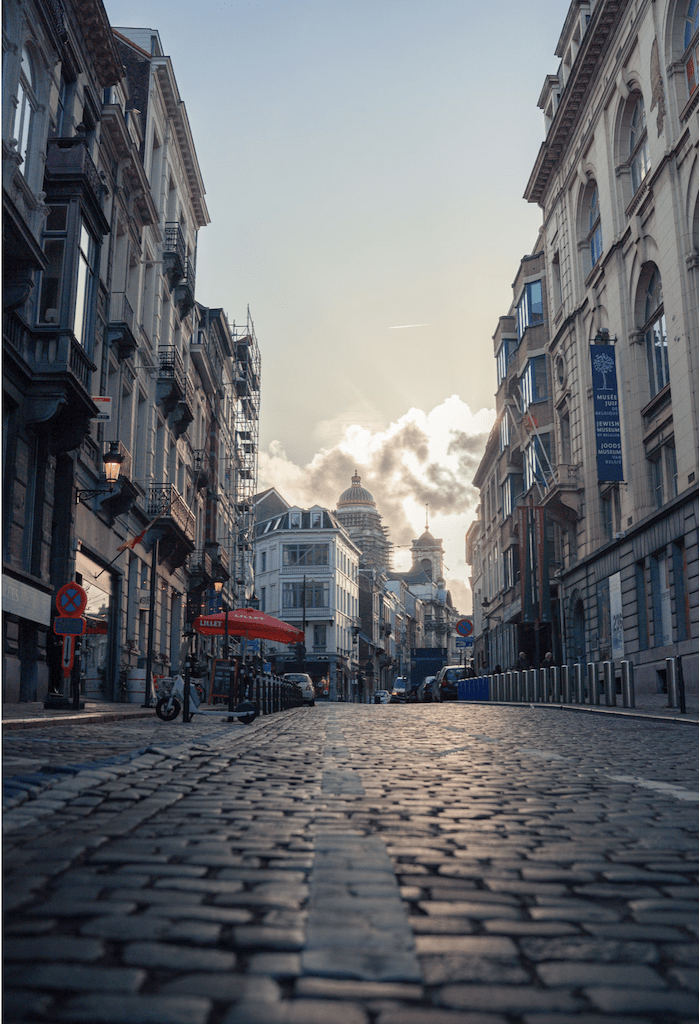
One of the best views in central Brussels is close by at Place Poelaert, beside the Palace of Justice. From this elevated position, the city spreads out below, making it a useful reminder of how many different districts sit within a relatively short distance of one another.
The Marolles works best when you leave room for unplanned stops. It is the sort of neighbourhood where an interesting shop window, café or market stall can easily change the next half-hour of your day.
Dansaert and Sainte-Catherine: design, food and old Brussels
West of the historic centre, Dansaert and Sainte-Catherine sit side by side but bring slightly different things to a city break.
Rue Antoine Dansaert has become one of Brussels’ best-known streets for independent fashion, Belgian designers, concept stores and contemporary shopping. Rather than large international chains dominating every block, there are plenty of smaller businesses to browse along the street and around the surrounding lanes.
Continue towards Sainte-Catherine and the focus shifts towards food and the area’s trading history. Long before this became one of central Brussels’ popular dining areas, this part of the city was connected with its port and fish market. That past is still reflected in several local place names and in the long-standing association between Sainte-Catherine and seafood restaurants.
The Church of Saint Catherine dominates the square, while the nearby Black Tower is a surviving piece of Brussels’ medieval fortifications. These historic details sit among busy restaurants, cafés and everyday city life rather than being separated into a museum-like quarter.
Dansaert and Sainte-Catherine are especially easy to visit after seeing the central sights. You do not need to plan a separate half-day excursion; simply keep walking west instead of ending your sightseeing at the Grand Place.
Matongé and Saint-Boniface: another side of Ixelles
South-east of the centre, Matongé offers a very different picture of Brussels.
The neighbourhood takes its name from the Matonge district of Kinshasa and is closely linked with Brussels’ African communities, particularly those with connections to the Democratic Republic of the Congo. Its streets contain African grocery shops, hair salons, restaurants, fabric stores and other independent businesses.
A short walk away, Saint-Boniface has a different feel again. The streets around the Church of Saint Boniface and Place Fernand Cocq are filled with cafés, bars and restaurants drawing on cuisines from many parts of the world.
There is architecture to look for as well. Several Art Nouveau façades designed by Ernest Blérot can be found on Rue Saint-Boniface, showing how easily Brussels mixes architectural interest into ordinary residential and commercial streets.
These areas are useful additions to an itinerary because they show a Brussels shaped not only by historic Belgian institutions and European politics, but also by generations of migration and communities from around the world.
Flagey and the Ixelles Ponds: architecture with room to breathe
Flagey is a strong choice when you want to move away from the dense streets of central Brussels without leaving city life behind.
Place Flagey is centred around the distinctive Flagey building, constructed in the 1930s for Belgium’s national radio broadcaster. The former broadcasting house now hosts concerts, film screenings and cultural events, and its strong geometric design makes it one of the area’s most recognisable buildings.
From the square, it is only a short walk to the Ixelles Ponds. The water, trees and surrounding residential streets create a slower pace than the city centre. Walking around the ponds also gives you a chance to see some of Brussels’ architectural heritage away from the busiest tourist streets, including houses influenced by Art Nouveau and Art Deco.
Continue further and you can reach the gardens of La Cambre Abbey. The abbey has roots stretching back to the early 13th century, while its landscaped gardens provide another peaceful place to walk.
This combination of cafés, cultural venues, water, architecture and green space makes Flagey and Ixelles particularly suited to an afternoon when you would rather explore at your own pace than follow a checklist of landmarks.
Saint-Gilles: Art Nouveau and everyday Brussels
Saint-Gilles lies south of the centre and rewards anyone interested in architecture and neighbourhood life.
The commune contains numerous Art Nouveau buildings, including work associated with architects such as Victor Horta and Ernest Blérot. You do not need to know much about architecture to enjoy them. Decorative ironwork, curved windows, tiled details and unusual façades make an ordinary walk through the residential streets much more interesting.
Parvis de Saint-Gilles is one of the main social centres of the area. Cafés and terraces surround the square, and a local market regularly brings extra activity to the neighbourhood. Nearby, the imposing Saint-Gilles Town Hall, completed in the early 20th century, is another building worth seeing.
Saint-Gilles is a good place to visit later in the day. Walk through the residential streets, look out for Art Nouveau details and then settle at one of the cafés around the Parvis rather than travelling straight back to the centre for dinner or a drink.
It is a simple way to experience a part of Brussels where tourism is present but does not define the entire neighbourhood.
Exploring Brussels without carrying your bags
Brussels is well suited to walking, especially when combining central neighbourhoods such as Sablon, Marolles, Dansaert and Sainte-Catherine. Once you start heading towards Ixelles, Flagey or Saint-Gilles, using the tram or metro for part of the journey can save time and energy.
Travelling light makes these neighbourhood days much easier. This can be useful on arrival day if your accommodation is not ready, or after checking out when your train or flight leaves later in the evening. In that situation, using Luggage Storage in Brussels through Radical Storage gives you the option to leave your bags behind rather than pulling a suitcase over pavements and cobbled streets while you explore.
Comfortable shoes are also a sensible choice. Brussels has hills, cobbles and plenty of streets where the most interesting route is not always the shortest one.
There is no need to fit every neighbourhood into a single day. Sablon and Marolles pair naturally, as do Dansaert and Sainte-Catherine. Flagey can easily be combined with the Ixelles Ponds, while Saint-Gilles deserves time of its own if architecture is one of your interests.
A different way to see the Belgian capital
The Grand Place deserves its reputation, and no first visit to Brussels would feel complete without seeing it. But it should be the starting point rather than the boundary of your trip.
A few streets beyond the busiest part of the centre, Brussels begins to change quickly. Sablon’s galleries and chocolate shops lead towards the flea market and second-hand stores of the Marolles. Dansaert mixes fashion and design with the old trading quarter around Sainte-Catherine. Matongé brings African influences into the heart of Ixelles, while Flagey, the ponds and Saint-Gilles reveal another side of the city’s architecture and daily life.
Exploring these neighbourhoods gives you something that a list of major attractions rarely can: a better sense of how Brussels actually fits together.
Leave enough space in your itinerary to wander, stop when somewhere looks interesting and occasionally take the street that was not part of the plan. In Brussels, that is often where the city becomes most memorable.